Note: A large portion of this post has been sitting in drafts for at least 6 months. I recently attended the Innovation Summit: AI & the Future of Learning put on by the Center for Academic Innovation at the University of Michigan. In the opening talk, James DaVaney, said a lot of this in five minutes (as well as in an IHE article) in a much more succinct and eloquent way.
Exercise is medicine.
I spent many Saturday mornings in my childhood running hard on a treadmill while hooked up to a metabolic cart. I was a willing guinea pig and got paid in baseball cards—the kind that came with a slab of rock-hard bubble gum tucked inside. It was for a good cause. Building on seminal work in the late 1970’s, my father’s and others’ research at this time was prescient: cardiovascular disease risk factors are influenced by childhood behavior1 2 and physical activity, especially aerobic exercise, in childhood can protect against heart disease later in life3 4. Further, children can learn to pace themselves during aerobic exercise to maximize the benefits5. More broadly, the health benefits of aerobic exercise are vast and indisputable6. It ranks up there with vaccinations as one of the most efficacious preventative public health interventions in the history of mankind. Exercise is medicine.
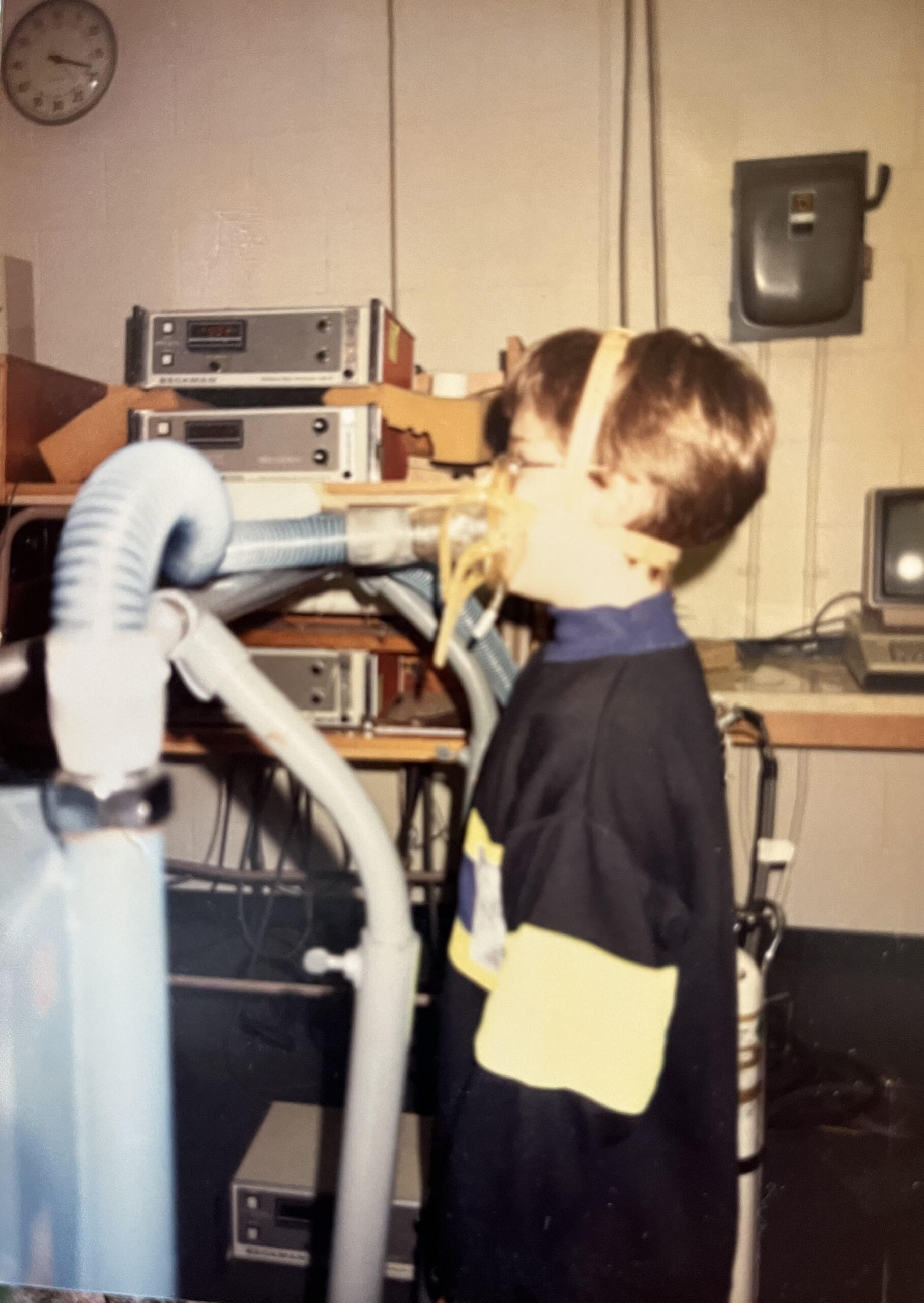
No matter how effortless fitness influencers make it look or the shortcuts they promote, the kind of exercise that strengthens our bodies and protects us from disease is slow, difficult, and painful. It requires physical discomfort and mental disequilibrium. I’ve often questioned the life choices that have placed me in the middle of a long, hot run and sworn off this seeming nonsense many times. Yet I continue to do it almost every day. The “exercise is medicine” mantra was embedded in my childhood by a father who still wears shirts emblazoned with it. I’m blessed to have had role models who demonstrated that the pain was worth it, participated with me, and taught me how to optimize the benefits. I’ve surrounded myself with a community where consistent and often punishing aerobic exercise is the norm. I preemptively mourn the day that this level of exercise and productive pain is taken from me. The pain of losing it is now greater than the pain of doing it.
Education is medicine.
While the direct causal relationship might not be as clear as with exercise7, the health benefits associated with education are vast and indisputable. Increasing levels of education are associated with reduced mortality and increased longevity, lower prevalence of chronic disease, improved mental health and cognitive functioning, and upward economic and social mobility.8 9 10
The kind of education—more specifically meaningful learning11—*that strengthens our minds and protects us from disease is slow, difficult, and painful. It requires considerable discomfort. It requires friction and inefficiency. In the parlance of Piaget it requires cognitive disequilibrium that leads to accommodation: cognitive discomfort that forces one to modify their mental framework to match new, discrepant, and challenging information. A degree of confusion or “contradictions, conflicts, anomalies, erroneous information, and other discrepant events” likely also plays a key role in meaningful learning when enacted in a supportive context.12 Research on “desirable difficulties” further explains how to properly scaffold cognitive discomfort in ways that maximizes durable learning gains versus short transient ones.13 14 Coincidentally, recent research suggests that learning with generative AI can produce short-term gains at the expense of long-term gaps in knowledge and higher order thinking skills.15 16 17 18 19 (More on this in a minute.) tl;dr: Meaningful and lasting learning that produces a myriad of positive benefits, including health outcomes, requires discomfort, confusion, and considerable sustained effort.
AI is Not (yet).
Despite enthusiastic rhetoric (which is putting it kindly) from Silicon Valley, it didn’t “save everything to click here” in the 2010’s and it’s not going to in the 2020’s. Father Guido Sarducci may be able to provide quality education at a fraction of the time, effort, and money, but generative AI alone cannot. AI didn’t create this rhetoric or problem. In the face of arduous, uncomfortable, delayed gratification activities—especially activities where their value is initially opaque20—humans’ general reaction is to optimize (aka avoid, shortcut, cheat). The least surprising thing to us should be that students vigorously pursue shortcuts, especially within the prevailing schooling structures we’ve created (more on this in a minute). Whether it’s Georgie selling Sheldon’s tests in the school bathroom or programming cheat sheets into a TI-82 calculator (or connecting a TI-84 to ChatGPT) or grabbing psets from CourseHero, the shortcuts have always been there. Sure, kicking off Einstein AI (we hardly knew ye!) to complete an entire Canvas course with a click is a whole new level of frictionless learning.
Maybe AI is way worse for learning than those other shortcuts with it’s cognitive debt, harmful sycophancy, and hollowed mind. Maybe (almost certainly) AI can be way better for learning than those shortcuts, and I’m optimistic groups like the National Tutoring Observatory will eventually get us there. But I’m not really here to talk about AI. AI didn’t create this problem. The use of generative AI in education and it’s impacts on the job market have just made it increasingly urgent to address the existing deficiencies and opportunities in our educational systems.
Controlled Efficiency is Not
If you get nothing else from this post, go read Steven Mintz’s essay, AI Killed the Take-Home Essay. COVID Killed Attendance. Now What?. It’s thoughtful, poignant, and vulnerable. It’s a real-time look at an instructor wresting with this moment and coming to a conclusion I want end on.
“I am trading the controlled efficiency of instructor-led classes for the messier, more unpredictable process of student-driven learning. But that trade feels necessary. The controlled efficiency was producing an illusion of learning. [emphasis added] The messiness may actually produce the real thing.”
Blaming students for taking shortcuts is largely a fundamental attribution error.21 It’s blaming a person rather than their situation. We (primarily educators and lawmakers) created this situation. We created the “grammar of schooling.22” We designed this situation, “more for efficiency and control than for learning or liberation.” While there are many possible explanations, we’ve created a schooling situation that contributes23 to a significant drop-off in student motivation and creativity around the transition to middle school.24 We’ve created a situation where effort is often perceived as wasteful and disconnected from a higher purpose.20
“hard but worth it.”
I’m responsible for end-term course evaluations for my university. Our analyses of student feedback has zeroed in on the kind of feedback that provides one of the strongest indicators of course “quality” (still a deeply flawed evaluation methodology): “that was hard but worth it.” The pain was worth it. I’m glad I didn’t take the shortcut.
The Long, Hard, Stupid Way
Chef David Chang is often attributed with the mantra, “the long, hard, stupid way” and an embrace of “gosaeng,” the hard life. In his memoir “Eat a Peach,” Chang describes how operationalizing this philosophy (in slightly pathological ways) is what drives the restless innovation that make his restaurants under the Momofuku brand and media activities under Majordomo Media so successful. It’s antithetical (a zag in The Ringer vernacular) to the cult of optimization and frictionless experiences championed by Silicon Valley.
“I have to try to create an environment where I’m trying to get that Cook to take the long stupid way. It’s so inefficient. And ultimately I think being a chef is one of the hardest jobs to motivate people because there’s no lure of a giant paycheck or bonus or stock options. You’re really trying to teach someone to better themselves through their own personal integrity.”
I’ve argued that like exercise, meaningful learning—the kind that leads to the acquisition of durable skills and positive health outcomes—requires discomfort and sustained effort in the face of uncertain results. I’ve argued that the controlled efficiency of our educational systems is antithetical to this type of learning. The use of AI to find shortcuts in the learning process is just a symptom of the larger problem with the way educational systems are designed. How do we create educational contexts in which students are less likely to take shortcuts and embrace the pain of learning? The task in front of us (always has been) is how to motivate students to take the long, hard, stupid way.
I’ll provide some practical applications by oversimplifying and slightly butchering (apologies in advance to Eccles, et al.) a theory of educational motivation and using it as an organizing framework. While the motivational research bench is deep here, this one has strong face validity and is often implicated in the design of educational contexts that help students get to the place where hard is worth it. Kurt Lewin, the father of social psychology, is famous for saying, “there’s nothing so practical as a good theory.” A good theory isn’t practical if a general audience can’t almost immediately nod their head in it’s general direction and begin to envisage how to operationalize it. (Many in the research community will vehemently disagree with me on this issue.) What follows is my ham-handed attempt (and also to just get this post off my desk!) to connect these concepts to practical solutions I’m hearing out the AI education crowd regarding where education needs to go in the age of AI.
Expectancy-value theory26 posits that motivation is a combination of one’s expectations (can I do this?) and value (is this worth doing?). It’s describes motivation as a product of expectancy and value. Both elements must be sufficiently established to support student motivation that guards against shortcuts and fosters persistence in the face of difficulty. One without the other is no good.
Expectancy (Can I do this?)
Apprenticeship and Experiential Learning
How can students have the expectation that they’ll ultimately be successful going down the hard educational path if they don’t get to continually test whether hard-won skills work in the real world? As I listened to the student panel at the Innovation Summit, I heard bright, articulate students from one of the world’s leading institutions express, subtly yet unmistakably, their concern about being prepared to succeed in a world increasingly shaped by AI. In addition to inconsistent or incoherent institutional policies about the use of AI in their studies, these students seemed quite uneasy about their preparation to navigate a job market where the entry level is falling off a cliff. The entry level needs to happen in conjunction with one’s studies, not after. I heard at the Summit that industry is having to create their own internal educational and apprenticeship programs because higher education isn’t producing what they need. While the bleeding heart academic in me is reluctant to say this—and this will warm James’s heart—higher education needs to dramatically increase industry partnerships and apprenticeships at a curricular, structural level. The current model isn’t working where we mostly leave students on their own to fight for a dwindling number of internships near the end of their academic career. Further, we need to set students up to experience this type of education-vocation integration over longer periods of time similar to the Stanford d.school’s notion of the Open Loop University (cc Robert Prakash, Carissa Little 😉 ) and the Futures Project on Education and Learning for Longer Lives initiative (cc Mitchell Stevens).
As an aside, we (especially elite institutions) need to stop the dualistic thinking and catastrophizing about becoming a vocational or online institution or being corrupted by industry. You’re brilliant people trained in the liberal arts. You have the tools to navigate the nuances of this relationship and retain your identity and autonomy. What’s more, this is an incredible opportunity to show students how the liberal arts can give them a leg up in the AI age. But they have to test these ideas in a safe yet real environment. They need to see how logic, philosophy, rhetoric, historical reasoning, critical thinking, quantitative reasoning etc. can be used to address real problems. These skills aren’t really durable until they’re tested, refined, and internalized. Only so much can happen in the classroom. How else are they going to become more confident in their success once they enter the job market? Again, AI didn’t create this problem or opportunity, it’s just made it impossible to ignore.
Mentorship
How can students expect success is at the end of the hard educational path if they don’t get continual encouragement from a role model who can show them the tangible steps to get there? I was blessed to have a father who mentored me on my journey to embracing exercise as medicine. He modeled this behavior and showed me what it looked like to be successful and made it seem attainable. He identified pitfalls and helped me maximize the gain from the pain. Mentors can show students that the hard way is worth it and give them the confidence that it will all work out. What’s more, positive adult role models and mentors protect against all manner of negative outcomes including poor educational attainment.27 28 Universities are uniquely set up to match mentors with students. Universities often create an incredible sense of shared identity (yes, athletics can play an important role) which greases the wheels of these relationships. We’re leaving so much social capital on the table by not doing a better job of connecting alumni and associated partners with students. Just as with their first-year class schedule, students should enter their college experience with a mentor and apprenticeship-type experiences already lined up.
Value (Is this worth doing?)
The Why
If we don’t constantly reinforce why the hard way matters, why would students choose and stick with it? I contend that just like content coverage and assessment and classroom management, continually communicating the value of education—both at the micro and macro levels—is our job as educators. The best educators have this in spades. Sometimes they raise the value through their own interest and excitement for the subject (intrinsic value). Other times they raise the value by talking about the usefulness of the content (utility value) or helping students to begin seeing what that are and can become (attainment value). Starting with why matters, and continually showing the forest, and interdisciplinary connections between forests, before diving back into the trees is essential to motivating students to continue on the hard path to meaningful learning.
CARE (inclusion and belonging)
How can someone see value in an activity that’s been designed in such a way that someone like them doesn’t belong? (And apologies to Eccles et al. as I’m really stretching their conceptualization here.) The controlled efficiency of education and grammar of schooling were designed in such a way that a small subset of students could thrive in a narrow path. If we don’t help students feel like they belong and are valued, they’re unlikely to persist and/or resist academic shortcuts. Valuing and including every student is a shared responsibility between the institution and instructors. It’s not just because this is the right thing to do, it also directly impacts academic achievement, especially for traditionally marginalized students. 29 30 31 32 We do incredible harm when we throw open our arms to students’ money (often in the form of debt) and tell them they belong and can explore the world here while placing them in a system where the margin for error is small and path narrow. While there are many models to choose from, my colleague Kritika Yegnashankaran and I developed the CARE approach which outlines 5 essential elements for design for inclusion and belonging: community, agency, representation, equal access, and pedagogies of care.
The hard learning path is expensive and inefficient for both students and educational systems. The enormous wealth in our society could be used to create the safe space and economic security needed to ensure everyone is able to enjoy this long, hard, and wonderfully rewarding process. But the majority in our society don’t have the economic margin or security to be inefficient in their education.
Coda: Kintsugi
At the first Harvesting Academic Innovation for Learning (HAIL) meeting almost a decade ago, James DaVaney used kintsugi—the Japanese art of repairing broken pottery with “golden joinery” that highlights the beauty of repair instead of hiding it—to describe our opportunity in higher education. If the academic social contract is up for renewal, then we have an unprecedented chance to show that we can address our problems straight on and provide solutions that only institutions of science and critical thinking can. But there’s no shortage of voices saying that higher education is broken and only they can fix it through technological optimization. Back then the edtech rhetoric was about online learning, especially from new industry players, leading to the closure of all but ten institutions of higher education. Today it’s a $400,000 education for $5,000 and AI-first schools with “guides” instead of teachers. But everything I’ve suggested can be done with real teachers in existing educational systems and can likely be augmented through the thoughtful use of AI. I think teachers and our systems, especially public education, are still best positioned to enact this change instead of offloading reform to the optimization gurus of Silicon Valley. But we need to admit the cracks of controlled efficiency have existed long before AI. This is the first step in our long, hard, stupid way. Meaningful learning has always been the exception rather than the rule. We need to leverage the urgency that AI is creating to move quickly and courageously. In this post, I’ve talked about a renewed focus on fostering student motivation as one solution. This is far from the only thing we should be doing if we are to some day look back and see the cracks fixed with golden joinery.
*While AI was used to surface some of the research cited in this post, all this clumsy prose is my own. I was overusing the em dash way before robots made it uncool.
- Freedman, D. S., Khan, L. K., Dietz, W. H., Srinivasan, S. R., & Berenson, G. S. (2001). Relationship of Childhood Obesity to Coronary Heart Disease Risk Factors in Adulthood: The Bogalusa Heart Study. Pediatrics, 108(3), 712–718. https://doi.org/10.1542/peds.108.3.712 ↩︎
- Childhood risk factors predict adult risk associated with subclinical cardiovascular disease: The Bogalusa Heart Study. (2002). The American Journal of Cardiology, 90(10), L3–L7. https://doi.org/10.1016/S0002-9149(02)02953-3 ↩︎
- Janssen, I., & LeBlanc, A. G. (2010). Systematic review of the health benefits of physical activity and fitness in school-aged children and youth. International Journal of Behavioral Nutrition and Physical Activity, 7(1), 40. https://doi.org/10.1186/1479-5868-7-40 ↩︎
- Janssen, I., & LeBlanc, A. G. (2010). Systematic review of the health benefits of physical activity and fitness in school-aged children and youth. International journal of behavioral nutrition and physical activity, 7(1), 40. ↩︎
- Saltarelli, W. A., & Andres, F. F. (1993). Teaching Steady Pacing to Students—A Practical Method. Journal of Physical Education, Recreation & Dance, 64(6), 67-70. ↩︎
- Penedo, F. J., & Dahn, J. R. (2005). Exercise and well-being: a review of mental and physical health benefits associated with physical activity. Current opinion in psychiatry, 18(2), 189-193. ↩︎
- Zajacova, A., & Lawrence, E. M. (2018). The relationship between education and health: reducing disparities through a contextual approach. Annual review of public health, 39, 273-289. ↩︎
- Hahn, R. A., & Truman, B. I. (2015). Education improves public health and promotes health equity. International journal of health services, 45(4), 657-678. ↩︎
- Cutler, D. M., & Lleras-Muney, A. (2006). Education and health: Evaluating theories and evidence. National bureau of economic research Cambridge, Mass., USA. https://www.nber.org/papers/w12352 ↩︎
- Lleras-Muney, A. (2005). The Relationship Between Education and Adult Mortality in the United States. The Review of Economic Studies, 72(1), 189–221. https://doi.org/10.1111/0034-6527.00329 ↩︎
- Bryce, T. G. K., & Blown, E. J. (2024). Ausubel’s meaningful learning re-visited. Current Psychology, 43(5), 4579-4598. ↩︎
- D’Mello, S., Lehman, B., Pekrun, R., & Graesser, A. (2014). Confusion can be beneficial for learning. Learning and Instruction, 29, 153-170. ↩︎
- Bjork, E. L., & Bjork, R. A. (2011). Making things hard on yourself, but in a good way: Creating desirable difficulties to enhance learning. Psychology and the real world: Essays illustrating fundamental contributions to society, 2(59-68), 56-64. ↩︎
- Bjork, R. A., & Bjork, E. L. (2020). Desirable difficulties in theory and practice. Journal of Applied research in Memory and Cognition, 9(4), 475. ↩︎
- Akgun, M., & Toker, S. (2025, July). Short-Term Gains, Long-Term Gaps: The Impact of GenAI and Search Technologies on Retention. In International Conference on Artificial Intelligence in Education (pp. 44-52). Cham: Springer Nature Switzerland. ↩︎
- Walker, K. and Vorvoreanu, M. (2025). Learning outcomes with GenAI in the classroom: A review of empirical evidence. Microsoft Technical Report MSR-TR-2025-42 October 2025. ↩︎
- Bastani, H., Bastani, O., Sungu, A., Ge, H., Kabakc?, Ö., & Mariman, R. (2025). Generative AI without guardrails can harm learning: Evidence from high school mathematics. Proceedings of the National Academy of Sciences, 122(26), e2422633122. ↩︎
- Klein, C. R., & Klein, R. (2025). The extended hollowed mind: why foundational knowledge is indispensable in the age of AI. Frontiers in Artificial Intelligence, 8, 1719019. ↩︎
- Weidlich, J., Gaševi?, D., Drachsler, H., & Kirschner, P. (2025). ChatGPT in Education: An Effect in Search of a Cause. Journal of Computer Assisted Learning, 41(5), e70105. https://doi.org/10.1111/jcal.70105 ↩︎
- André, N., Baumeister, R. F., Gendolla, G. H., & Audiffren, M. (2026). Do people really avoid effort? A cost–benefit perspective on the principle of least effort. Neuroscience & Biobehavioral Reviews, 106587. ↩︎
- Ross, L. (2018). From the Fundamental Attribution Error to the Truly Fundamental Attribution Error and Beyond: My Research Journey. Perspectives on Psychological Science, 13(6), 750–769. https://doi.org/10.1177/1745691618769855 ↩︎
- Tyack, D., & Tobin, W. (1994). The “Grammar” of Schooling: Why Has it Been so Hard to Change? American Educational Research Journal, 31(3), 453–479. https://doi.org/10.3102/00028312031003453 ↩︎
- Wang, M.-T., & Eccles, J. S. (2013). School context, achievement motivation, and academic engagement: A longitudinal study of school engagement using a multidimensional perspective. Learning and Instruction, 28, 12–23. https://doi.org/10.1016/j.learninstruc.2013.04.002 ↩︎
- Anderman, L. H., & Midgley, C. (1998). Motivation and Middle School Students. ERIC Digest. ↩︎
- André, N., Baumeister, R. F., Gendolla, G. H., & Audiffren, M. (2026). Do people really avoid effort? A cost–benefit perspective on the principle of least effort. Neuroscience & Biobehavioral Reviews, 106587. ↩︎
- Wigfield, A., & Eccles, J. S. (2000). Expectancy–Value Theory of Achievement Motivation. Contemporary Educational Psychology, 25(1), 68–81. https://doi.org/10.1006/ceps.1999.1015 ↩︎
- Hurd, N. M., Zimmerman, M. A., & Xue, Y. (2009). Negative Adult Influences and the Protective Effects of Role Models: A Study with Urban Adolescents. Journal of Youth and Adolescence, 38(6), 777–789. https://doi.org/10.1007/s10964-008-9296-5 ↩︎
- Howard, A. H., Gwenzi, G. D., Taylor, T., & Wilke, N. G. (2023). The relationship between adverse childhood experiences, health and life satisfaction in adults with care experience: The mediating role of attachment. Child & Family Social Work, 28(3), 809–821. https://doi.org/10.1111/cfs.13006 ↩︎
- Miyake, A., Kost-Smith, L. E, Finkelstein, N.D., Pollock, S. J., Cohen, G. L., & Ito, T. A. (2010). Reducing the gender achievement gap in college science: A classroom study of values affirmation. Science, 330(6008), 1234-1237. ↩︎
- Kizilcec, R. F., Saltarelli, A. J., Reich, J., & Cohen, G. L. (2017). Closing global achievement gaps in MOOCs. Science, 355(6322), 251-252. ↩︎
- Walton, G. M., & Cohen, G. L. (2011). A Brief Social-Belonging Intervention Improves Academic and Health Outcomes of Minority Students. Science, 331(6023), 1447–1451. https://doi.org/10.1126/science.1198364 ↩︎
- Harackiewicz, J. M., Canning, E. A., Tibbetts, Y., Giffen, C. J., & Hyde, J. S. (2014). Closing the social class achievement gap for first-generation students in undergraduate biology. Psychological Science, 25(4), 943-953. ↩︎
Brilliant. I, too, have been thinking about the idea that “higher education needs to dramatically increase industry partnerships and apprenticeships at a curricular, structural level.” The brittle security of self-importance afforded to each sector by keeping them discreet not only harms students but precludes unknowable advances that could serve to *humanize* work experiences for billions.